
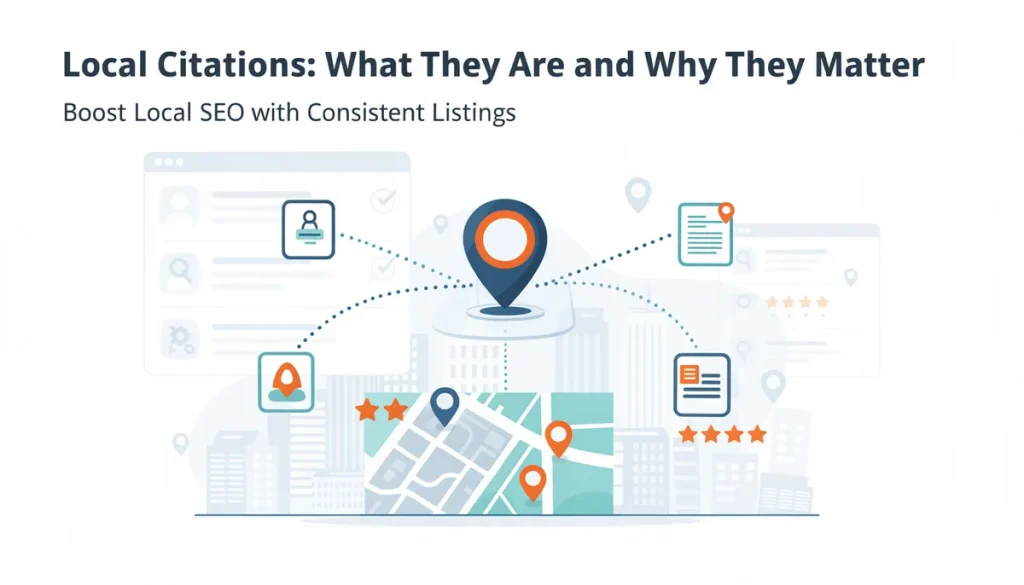
Local citations SEO is one of those topics that sounds more complicated than it actually is. A citation is simply any online mention of your business name, address, and phone number (NAP). That mention can appear on a business directory, a social media profile, a government database, a news article, or any other website.
Search engines use these third-party mentions to verify that your business is real, confirm where it is located, and assess how established it is. Think of citations as reference checks. The more consistent, authoritative sources that confirm the same details about your business, the more confident Google becomes about showing you in local results.
How Do Citations Influence Local Search Rankings?
Citations function as one of several signal groups that Google uses to rank local businesses. Current local ranking factor studies place citation signals at approximately 7% of overall local pack influence. That makes them the smallest individual signal category, but that number is misleading on its own.
Citations do not operate in isolation. They serve as the data consistency layer that allows other signals (your Google Business Profile, reviews, website content) to work properly. If your NAP is inconsistent across the web, Google loses confidence in your profile data, which weakens every other signal you have built.
| Local Ranking Signal | Approximate Influence |
|---|---|
| Google Business Profile signals | 32% |
| Review signals | 20% |
| On-page signals | 19% |
| Link signals | 15% |
| Behavioral signals | 8% |
| Citation signals | 7% |
The real impact of citations is not the direct ranking boost. It is removing confusion. A business with 50 consistent, accurate citations across reputable sources gives Google zero reason to doubt its legitimacy. A business with conflicting information across directories forces Google to guess, and Google responds to uncertainty by ranking you lower.
What Types of Citations Exist?
Not all citations are created equal. Understanding the categories helps you prioritize where to invest time.
Structured citations appear in a fixed format on business directories and listing sites. These have dedicated fields for business name, address, phone number, website, hours, and category. Your Yellow Pages listing, your Yelp profile, and your BBB page are all structured citations.
Unstructured citations are mentions of your business information within regular content. A local news article mentioning your business name and address, a blog post referencing your company, or a chamber of commerce event listing are all unstructured citations. These carry less direct ranking weight but contribute to overall web presence and authority.
Core citations are the foundational platforms that Google actively cross-references. These are non-negotiable:
- Google Business Profile
- Apple Maps
- Bing Places
- Yellow Pages (country-specific)
- BBB (Better Business Bureau)
- Yelp
Industry-specific citations are directories relevant to your particular business type. A restaurant has different priority directories than a law firm or a plumber. These often carry more weight per citation than general directories because the relevance signal is stronger.
Why Does NAP Consistency Matter So Much?
NAP consistency is the single most important factor in citation management. Your business name, address, and phone number must be identical everywhere they appear online. Not similar. Identical.
Common inconsistencies that cause problems:
- “Durham SEO” vs “Durham SEO Inc.” vs “Durham S.E.O.”
- “123 Main St” vs “123 Main Street” vs “123 Main St.”
- “(905) 555-1234” vs “905-555-1234” vs “9055551234”
- Suite numbers included on some listings but not others
- Old phone numbers still live on outdated directories
Each variation creates a separate data point that Google must reconcile. When the variations pile up, Google cannot determine which version is correct. The result is lower confidence in your listing, which translates directly to lower rankings.
This is why citation cleanup often needs to happen before any new citation building. There is no point adding more listings if your existing ones contradict each other.
Which Citation Sources Matter Most for Canadian Businesses?
Not every directory carries equal weight. A citation on a high-authority, frequently crawled platform is worth significantly more than one on an obscure directory that nobody visits. Some industry research suggests that a listing on a platform like BBB carries 10 to 15 times more ranking influence than a random free directory.
Tier 1 (highest priority, build these first):
- Google Business Profile
- Apple Maps / Apple Business Connect
- Bing Places for Business
- Yelp Canada
- Yellow Pages Canada (YP.ca)
- BBB (Better Business Bureau)
- Facebook Business Page
Tier 2 (strong Canadian directories):
- Canada411
- Canpages
- Hotfrog Canada
- Industry Canada (federal business registry)
- Local chamber of commerce
- Provincial business registries
Tier 3 (industry-specific, varies by business type):
- Industry association directories
- Local business improvement area (BIA) listings
- Professional licensing body directories
- Niche review sites relevant to your service
The practical approach is to secure your Tier 1 listings first with perfect accuracy, then work through Tier 2, and only pursue Tier 3 if the directories are genuinely relevant to your industry. Submitting to 200 random directories because they exist is a waste of time in 2026.
How Do You Build Citations the Right Way?
Citation building is straightforward but requires patience and attention to detail. Rushing through it with copy-paste errors defeats the entire purpose.
Step 1: Establish your canonical NAP. Write out your exact business name, full address (with consistent formatting), and primary phone number. This is your source of truth. Every listing must match it character for character.
Step 2: Audit existing citations. Before building new ones, find out what already exists. Searching your business name and phone number will reveal current listings. Note any that have incorrect information.
Step 3: Correct inaccurate listings first. Claim profiles where possible and update them. For sites you cannot edit directly, submit update requests. This cleanup phase can take weeks because some directories are slow to process changes.
Step 4: Build new citations systematically. Work through directories in priority order. Complete every available field on each platform, not just NAP. Categories, descriptions, hours, photos, and service areas all strengthen the listing.
Step 5: Track and monitor. Citations can change. Directories merge, platforms update their data from aggregators, and sometimes user-submitted edits override your information. Check your key citations quarterly.
What Are the Most Common Citation Mistakes?
Businesses make a few predictable errors with citations that undermine their local SEO:
Duplicate listings on the same platform. If you have two Yellow Pages listings for the same business (maybe from a previous owner or a past attempt you forgot about), both listings become weaker. Merge or remove duplicates.
Abandoning old citations after a move or name change. If your business moved addresses three years ago but old directories still show the previous location, that confusion persists in Google’s data. Track down and update or remove every old listing.
Mass-submitting to low-quality directories. Hundreds of listings on directories that exist solely for link building add no value and may actually trigger spam signals. In 2026, Google cares about the quality and legitimacy of the sites where your business appears. Ten citations on platforms that real people use outperform a hundred on sites nobody visits.
Inconsistent categories across platforms. If you are listed as “Marketing Agency” on one directory and “SEO Consultant” on another and “Digital Marketing” on a third, you are diluting your relevance signal. Choose the category that best matches your primary service and use it consistently.
Ignoring your website URL. Your website link is part of the citation. If some directories point to your homepage, others to an old landing page, and others to a URL that now 404s, you are leaving value on the table and possibly creating negative signals.
How Long Does It Take for Citations to Impact Rankings?
Citations are not instant. After submitting or correcting a listing, you are waiting for two things to happen: the directory to publish or update the listing, and Google to crawl that directory and process the new information.
Typical timelines:
- Major directories (Google, Yelp, BBB): Changes reflect in 1 to 4 weeks
- Mid-tier directories: 2 to 8 weeks for processing
- Aggregator-fed directories: Can take 2 to 4 months because changes propagate through intermediate data sources
- Impact on rankings: Gradual improvement over 1 to 3 months as multiple citations process simultaneously
This is why citation work belongs in the first phase of any local SEO campaign. The sooner you start, the sooner the results compound with your other optimization efforts. Waiting until month four to begin citation building means waiting until month seven or eight to see the full effect.
When Should You Focus on Citations vs. Other Local Signals?
Citations are foundational but not the highest-leverage activity for every business at every stage. Here is how to prioritize:
Focus on citations first if:
- You have never done systematic citation building
- Your NAP is inconsistent across the web
- You recently changed your business name, address, or phone number
- You are a new business with minimal online presence
Focus on other signals first if:
- Your citations are already clean and consistent (40+ accurate listings)
- Your review count is below 20
- Your GBP profile is incomplete
- Your website has significant technical issues
Once citations are clean and consistent, they require minimal ongoing maintenance. Quarterly audits catch the occasional drift. Your time is better spent on reviews, content, and GBP activity at that point, because those signals have larger ongoing influence and require continuous work to maintain.
The foundation matters, though. Trying to build review volume and GBP authority on top of inconsistent citations is like furnishing a house before pouring the foundation. Everything you build on top is less stable than it should be.