
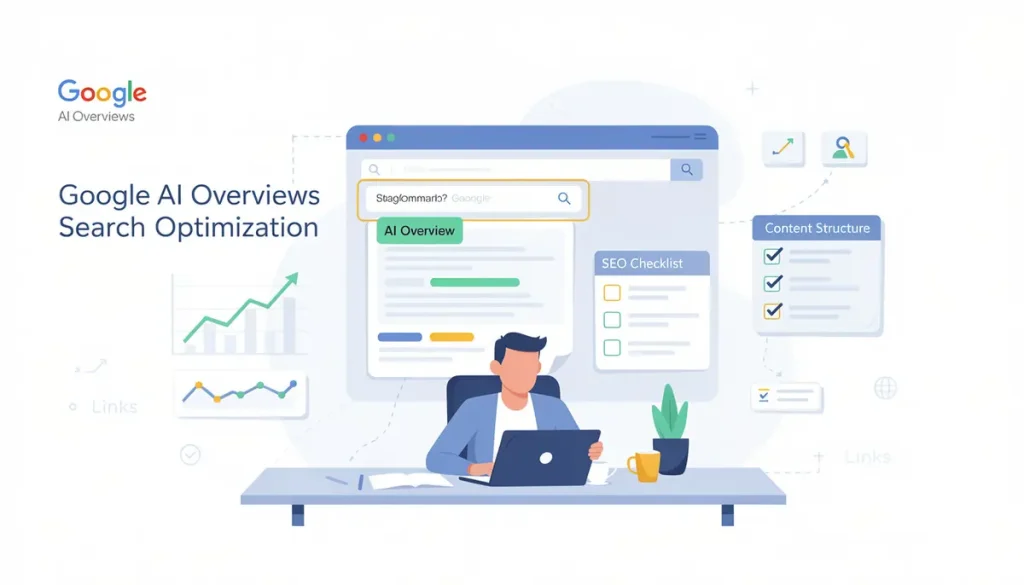
Google AI Overviews have changed what it means to rank in search. These AI-generated answer boxes appear at the very top of results, above organic listings, above ads, above the map pack, synthesizing information from multiple sources into a single response. They now trigger on roughly a quarter to half of all Google searches, depending on query type, and they are still expanding.
For businesses and content creators, the equation has shifted. Traditional position one rankings lose 34 to 64% of their clicks when an AI Overview appears above them. The citations within the AI Overview are now the most visible positions in search. Getting your content cited there is becoming as important as ranking organically.
What Are Google AI Overviews and How Do They Work?
AI Overviews are Google’s AI-generated summaries that appear at the top of search results for queries where a synthesized answer would be helpful. Google’s language model reads multiple web pages, extracts relevant information, combines it into a coherent answer, and cites the sources it drew from.
Each AI Overview typically:
- Appears above all other search results
- Synthesizes information from 2 to 6 cited sources
- Pulls from an average of 4 unique domains per overview
- Includes clickable links to the cited sources
- Triggers most frequently on informational and question-based queries
The system does not simply copy text from one source. It combines information across multiple pages to build a comprehensive answer. Being one of those cited sources means your brand appears at the most visible position in search results with direct attribution.
Which Queries Trigger AI Overviews?
Not all searches produce an AI Overview. Understanding which queries trigger them helps you target your optimization effort where it matters.
| Query Type | AI Overview Trigger Rate | Example |
|---|---|---|
| Question-form queries | High (up to 65%) | “What is schema markup?” |
| Informational long-tail | High | “How to fix slow WordPress site” |
| Comparison queries | Medium-High | “Local SEO vs national SEO” |
| “Best” and recommendation queries | Medium | “Best approach to local citations” |
| Commercial research | Medium | “SEO audit cost” |
| Navigational queries | Low | “Google Search Console login” |
| Local intent queries | Low-Medium | “SEO agency near me” |
The pattern: the more a query asks for information that can be synthesized from multiple sources, the more likely an AI Overview appears. Simple navigational queries and highly local queries trigger them less frequently.
How Does Google Select Sources for AI Overview Citations?
Google does not randomly select pages to cite. Research into citation patterns reveals specific factors that increase your odds of being selected:
Domain authority matters, but is not exclusive. Most cited sources have strong domain authority, but niche sites with deep topical expertise get cited for queries in their specialty. A small business site that is the most comprehensive source on a specific subtopic can outcompete larger sites.
Content structure determines extractability. Google’s AI needs to pull specific passages from your content. Pages with clear, self-contained sections that directly answer specific questions are easier to extract from than pages with information buried in long paragraphs.
Ranking position correlates with citation. Pages ranking in the top 10 organically are cited more frequently, but this is correlation, not strict causation. The same factors that help you rank (quality, relevance, authority) also make you citation-worthy.
Structured data provides verification. Schema markup helps Google’s AI verify claims and understand entity relationships. Pages with proper structured data get cited more than equivalent pages without it.
Freshness matters for time-sensitive topics. For queries where current information is relevant, recently-updated pages get cited over older content.
How Do You Structure Content for AI Extraction?
The biggest optimization lever is making your content easy for AI systems to extract specific, useful passages. This is a structural challenge, not a writing quality challenge.
Write extractable passages.
Each section should start with a direct 1 to 2 sentence answer to the question implied by the heading. This passage should make sense in isolation, without needing the rest of the page for context. Optimal extractable passages are 130 to 170 words, start with a definition or direct statement, and contain specific named entities.
Use question-format headings.
Headings phrased as questions map directly to the queries that trigger AI Overviews. “How long does local SEO take?” as an H2 heading followed by a direct answer makes it trivial for Google’s AI to match your content against that query and extract the answer.
Make sections self-contained.
Each H2 section should answer one specific question completely. It should not require reading previous sections for context. AI systems extract individual sections, not entire pages. A section that depends on context established three paragraphs earlier in a different section is less extractable.
Include structured elements.
Tables, numbered lists, and comparison formats provide structured information that AI systems can parse cleanly. A table comparing three options with clear columns is easier for AI to extract and present than the same information written as prose paragraphs.
Front-load specifics.
Start sections with the concrete answer, then provide context. “Local SEO typically takes 3 to 6 months for visible results” is extractable. “There are many factors that influence how long SEO takes, and different businesses will see different timelines depending on their situation” is not.
What Content Signals Increase Citation Probability?
Beyond structure, several content quality signals correlate with higher citation rates in AI Overviews:
Named entities and specific details. Passages with specific names, numbers, dates, and concrete references get cited more than vague statements. “Google removed 13 million fake profiles in 2025” is more citeable than “Google regularly removes fake listings.”
Original data or unique perspective. If your content contains information not found elsewhere (proprietary data, unique case studies, original research), AI systems are more likely to cite it because they cannot synthesize that information from other sources.
Topical authority demonstrated across multiple pages. Sites with deep coverage of a topic (topic clusters with multiple interlinked pages) get cited more for queries within that topic than sites with a single page on the subject.
Accurate, verifiable claims. Google’s AI cross-references claims against other sources. Content that aligns with consensus information (while adding unique value on top) is more trustworthy to cite than content making unsupported claims.
How Do AI Overviews Affect Your Traditional SEO Strategy?
AI Overviews do not replace the need for organic rankings. They add a layer on top. The sites most likely to get cited are the ones that already rank well organically. The optimization strategies overlap significantly:
| Traditional SEO Best Practice | AI Overview Benefit |
|---|---|
| Comprehensive topic coverage | Demonstrates authority on the topic |
| Question-format headings | Maps directly to queries triggering overviews |
| Clear, direct answers | Creates extractable passages |
| Structured data/schema | Helps AI verify and understand content |
| Internal linking/topic clusters | Builds topical authority signals |
| Fresh, updated content | Signals current relevance |
The difference: traditional SEO optimizes for ranking position. AI overview optimization focuses on extractability and citation worthiness. A page can rank first but not get cited (if its content is hard to extract) or get cited without ranking first (if it provides the clearest answer to a specific sub-question).
The practical implication: continue doing everything you would for traditional SEO, but add a structural layer that makes each section independently extractable.
How Do You Measure AI Overview Performance?
Measuring whether your content appears in AI Overviews is harder than tracking traditional rankings because AI Overview citations vary by user, location, and device.
Available measurement approaches:
- Google Search Console: Shows impressions and clicks from search features, though AI Overview data is still being integrated into reporting
- Manual spot-checking: Search your target keywords and observe whether your content appears in the AI Overview
- Third-party tracking tools: Some SEO platforms now track AI Overview citations alongside traditional rankings
- Traffic pattern analysis: Pages cited in AI Overviews often show increased impressions without corresponding increases in click-through rate (users see your brand but get the answer from the overview itself)
The metric to watch is shifting from “ranking position” to “citation share,” meaning what percentage of AI Overviews for your target topics include your content as a cited source.
What Should You Do Right Now?
If your existing content already ranks on page one for informational queries, you are positioned well. Focus these optimizations on your highest-traffic informational pages first:
- Add a direct, extractable answer (1 to 2 sentences) immediately below every H2 heading
- Rephrase H2 headings as questions where natural
- Add tables or structured lists to sections that present comparative information
- Ensure schema markup is properly implemented (Article, FAQ, Organization)
- Update any outdated statistics or claims with current data
- Break long, contextually-dependent sections into self-contained blocks
These changes benefit traditional SEO simultaneously. Clearer structure, better answers, and fresher content improve rankings regardless of AI Overviews. You are not optimizing for one at the expense of the other. You are making content better for both humans and AI systems, which is where search is heading.