
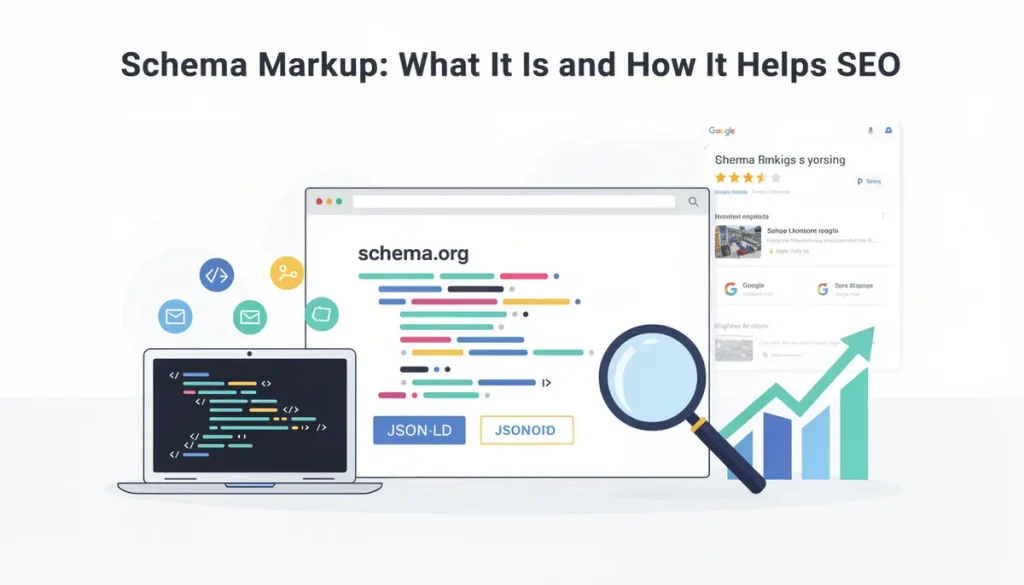
Schema markup is code you add to your website that tells search engines exactly what your content means, not just what it says. Without schema, Google reads your page as text and infers meaning from context. With schema, you explicitly state “this is a local business,” “this is a FAQ,” “this is a product with this price,” removing ambiguity from the equation.
The practical result: pages with valid schema markup become eligible for rich results (enhanced search listings with star ratings, FAQ dropdowns, pricing, images, or other visual elements that standard listings lack). They also provide clearer signals to AI systems that synthesize answers from web content, making your pages more likely to be cited in AI-generated responses.
How Does Schema Markup Work?
Schema markup uses a standardized vocabulary (schema.org) to describe content in a machine-readable format. You embed it in your page’s HTML, typically as JSON-LD (JavaScript Object Notation for Linked Data) in the page’s head section.
When Googlebot crawls your page, it reads this structured data alongside your visible content. The schema provides explicit context: this page is about a LocalBusiness located at this address with this phone number. This page is a BlogPosting published on this date by this organization. This page contains a Product available at this price.
Google uses this information for two purposes:
- Rich results display: Rendering enhanced search listings with visual elements (stars, prices, FAQs, event dates, recipe cards)
- Knowledge and entity understanding: Building its knowledge graph and helping AI systems verify facts, establish entity relationships, and assess source credibility
The second purpose has grown significantly. Google’s AI systems now use structured data as a trust verification mechanism during answer generation, not just as a display trigger for rich results.
Which Schema Types Matter Most for SEO?
Not all schema types produce visible results. Focus your implementation on the types that either earn rich results in search or provide significant entity signals.
| Schema Type | Rich Result Possible | Best For | Priority |
|---|---|---|---|
| LocalBusiness | Knowledge panel, map features | Local businesses | High |
| Organization | Knowledge panel | All businesses | High |
| Article / BlogPosting | Article cards, Top Stories | Blog content | High |
| FAQ | FAQ dropdown in SERPs | Pages with Q&A content | Medium |
| Product | Price, availability, ratings in SERPs | E-commerce | High |
| Breadcrumb | Breadcrumb trail in SERPs | All sites | High |
| Review / AggregateRating | Star ratings in SERPs | Products, services | Medium |
| Event | Event details in SERPs | Event listings | Medium |
| HowTo | Step-by-step display | Tutorial content | Low (reduced visibility since 2023) |
| Speakable | Voice search eligibility | News/article content | Low |
Google reduced rich result eligibility for FAQ and HowTo schema types after widespread abuse. They still work on genuinely qualifying pages but display far less frequently than they did before 2023. Do not add FAQ schema to pages that are not genuinely FAQ content.
How Does Schema Help Local SEO?
For local businesses, LocalBusiness schema is particularly powerful. It explicitly communicates your business name, address, phone number, hours, services, and geographic service area in a format Google can parse without interpretation.
What LocalBusiness schema should include:
- Business name (matching your Google Business Profile exactly)
- Full address (matching your GBP and citations)
- Phone number
- Website URL
- Opening hours (including special hours)
- Price range
- Service area (for service-area businesses)
- Accepted payment methods
- Founding date
This reinforces the NAP consistency that local SEO depends on. When your schema, GBP, website text, and citations all confirm the same information, Google’s confidence in your business data increases. That confidence translates to stronger local rankings.
For businesses with multiple locations, each location page should have its own LocalBusiness schema with that location’s specific details.
How Does Schema Interact With AI Search?
This is the most significant development in structured data’s role. Google’s AI-powered features (AI Overviews, AI Mode) use schema markup not just for display but for content verification during answer synthesis.
When AI systems generate answers, they assess source credibility. Structured data that accurately describes content provides a verification layer. A page claiming to list “10 best restaurants in Durham” that also has proper LocalBusiness or Article schema with consistent entity information appears more trustworthy to AI systems than a page making claims without structured backing.
Schema types that influence AI citation:
- Organization schema: Establishes your brand as a known entity
- Article schema with author and publisher: Establishes content provenance
- FAQ schema: Provides pre-structured Q&A that AI systems can directly reference
- LocalBusiness schema: Confirms physical presence and service details
The shift is important: schema used to be purely about earning visual enhancements in traditional search results. It now also determines whether AI systems trust and cite your content. This means schema implementation has value even when it does not produce a visible rich result.
How Do You Implement Schema Markup?
The recommended format is JSON-LD, placed in a <script> tag in your page’s HTML head. Google explicitly prefers JSON-LD over the older Microdata and RDFa formats.
Implementation approaches by platform:
WordPress: Use an SEO plugin that generates schema automatically based on your content type and fields. Many plugins handle Article, Organization, and Breadcrumb schema without manual code. For custom schema (FAQ, LocalBusiness, Product), use a dedicated schema plugin or add JSON-LD manually to your theme templates.
Custom sites: Generate JSON-LD server-side based on your content management system’s data. Map your CMS fields to schema.org properties and inject the resulting JSON-LD into each page’s head.
Static sites: Add JSON-LD blocks directly to page templates. For blogs, create a template that generates Article schema dynamically from the post’s metadata.
Key implementation rules:
- Schema must accurately reflect visible page content. Do not markup content that is not on the page.
- One Organization or LocalBusiness schema per site (typically on the homepage, referenced from other pages)
- Article or BlogPosting schema on every content page
- Breadcrumb schema site-wide
- FAQ schema only on pages that genuinely contain FAQ content
- Validate all schema with Google’s Rich Results Test before deploying
What Mistakes Should You Avoid With Schema?
Google has tightened enforcement on schema misuse. The March 2026 core update specifically targeted sites that implemented schema as a manipulation tactic rather than an accurate content description.
Common mistakes:
- Adding FAQ schema to non-FAQ pages. If the page is a regular article that does not present content in question-and-answer format, FAQ schema is misleading. Google will ignore it or penalize eligibility.
- Adding Review schema for self-reviews. Reviewing your own business or services violates Google’s guidelines. Review schema should reflect genuine third-party reviews.
- Marking up invisible content. Schema must describe content visible to users. Hidden content marked up with schema is considered deceptive.
- Inaccurate business information. LocalBusiness schema with details that do not match your GBP or actual business information creates conflicting signals rather than reinforcing them.
- Over-marking trivial content. Not every page needs every possible schema type. Implementing irrelevant schema adds code bloat without benefit and can make your legitimate schema less trustworthy.
The principle: schema should describe what is actually on the page, accurately and completely. It is a communication layer, not a ranking trick.
How Do You Validate and Monitor Schema?
After implementing structured data, validate it and monitor ongoing performance:
Validation (before and after deployment):
- Use Google’s Rich Results Test to check individual URLs
- Use Search Console’s Rich Results report for site-wide validation
- Check for errors (required fields missing), warnings (recommended fields missing), and eligibility issues
Ongoing monitoring:
- Google Search Console shows which pages have valid structured data and which have errors
- The Enhancements section shows rich result eligibility by schema type
- Monitor for new errors after site updates, plugin changes, or content modifications
Performance measurement:
- Track click-through rate (CTR) changes for pages before and after rich result eligibility
- Monitor which schema types earn visible rich results for your pages
- Check if AI-generated answers cite your content more frequently after implementation
Schema is not a set-and-forget implementation. Site updates, CMS changes, and plugin updates can break structured data without warning. A quarterly audit of your schema validation status catches issues before they impact search performance.
What Is the ROI of Schema Markup?
Schema does not cost ongoing money like advertising. It is a one-time implementation with ongoing maintenance. The returns come from:
- Higher CTR from rich results: Pages with star ratings, FAQ dropdowns, or pricing visible in search results earn more clicks than plain blue links competing for the same position
- AI citation eligibility: Proper schema increases the probability of being cited in AI-generated answers, which is a growing traffic source
- Clearer entity signals: Stronger entity understanding can support rankings across all pages associated with your brand
- Reduced ambiguity: Google understanding your content correctly means fewer misclassification issues and more appropriate query matching
The specific CTR improvement varies by industry and schema type. Star ratings in search results are among the most impactful visual enhancements, with studies showing 15-30% CTR improvements for pages that earn them. FAQ rich results, while less frequently displayed than before, still provide significant visual real estate when they appear.
Schema markup will not transform a poorly-performing page into a top ranker. It amplifies existing search performance by making your listings more visible and your content more trustworthy to both traditional algorithms and AI systems. For sites already producing quality content and building authority, schema is the technical layer that extracts more value from that existing investment.